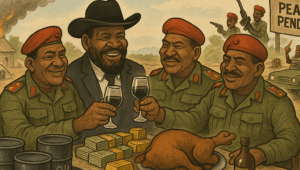
South Sudan’s economy is primarily reliant on oil, which provides a large percentage of government revenue. However, mishandling of these resources has been a significant source of corruption. The lack of openness in oil income management has allowed officials to divert funds for personal gain, depriving the country of essential resources for development.
Oil revenues are frequently used to consolidate power, with political elites controlling budget allocation to maintain their dominance. This dominance enables them to finance patronage networks and suppress criticism, thereby reinforcing corruption. Furthermore, the lack of clear and open methods for tracking oil income makes it impossible to punish authorities responsible for embezzlement.
The lack of revenue transparency has also discouraged foreign investment and aid, as international partners are reluctant to contribute to a corrupt system. To fight this, South Sudan must impose severe measures to promote openness in the oil business, such as independent audits and public disclosure of revenue and expenditure.
Here are some of the ways that enable corruption to thrive with impunity:
A). Public Sector Payroll and Ghost Workers.
One of the most serious kinds of corruption in many nations, including South Sudan, is the presence of ghost workers in the public sector payroll system. One of the major drivers of corruption in South Sudan is the manipulation of public sector payrolls.
What Is the Definition of Ghost Workers?
Ghost workers are fake employees who appear on the government payroll but do not exist or work in the public sector. Corrupt authorities or intermediaries typically collect their salaries, diverting public cash away from legitimate employees and services.
How Ghost Workers Affect South Sudan.
For years, South Sudan’s payroll system has been plagued by ghost workers, particularly in the civil service and security forces. This problem arose largely because of careless administrative procedures and a lack of effective verification systems.
The repercussions are serious.
- Financial Drain: Paying salaries to nonexistent personnel results in significant waste. These revenues might be used to assist vital public services, including healthcare, education, and infrastructure development.
- The existence of phantom workers undermines public trust in government organizations. Genuine public personnel may become demoralized when they witness corruption draining their hard-earned salary and resources.
- Ghost workers increase payrolls, straining the country’s limited budget. This weakens institutions. This inefficiency makes it harder to adequately fund and sustain government institutions, resulting in increased dysfunction.
- High-ranking politicians frequently use payroll fraud to reward allies and maintain patronage networks. This reinforces a culture of corruption and cronyism.
Fraudulent salary payments are enabled by inadequate oversight and a lack of correct personnel records. Payroll administrators can easily add false names to the list and collect salary for these nonexistent employees for themselves. Payroll administrators frequently use the funds they earn through this strategy to cover personal costs or maintain patronage networks.
Furthermore, the public sector in South Sudan is characterized by bloated government institutions with more jobs than needed, which are frequently filled through nepotism. Overstaffing not only burdens the national budget, but it also fosters inefficiency and corruption. To overcome these difficulties, the government must implement broad civil service reforms, such as payroll audits and the use of biometric technologies to authenticate employee IDs.
B). Weak Legal Frameworks and Enforcement.
South Sudan’s legal framework is inadequate for successful anti-corruption efforts. Laws designed to prevent and punish corrupt behavior are either ineffective or inadequately enforced. This legal gap fosters a climate in which corrupt officials can act with impunity, knowing that the chances of facing penalties are slim.
Due to a lack of legal deterrents, offenders of corrupt actions are rarely prosecuted or penalized. This lack of accountability encourages others to engage in similar actions, continuing the corruption cycle. Furthermore, law enforcement organizations frequently lack the required training and resources to conduct efficient investigations and prosecutions of corruption.
To boost the fight against corruption, South Sudan’s legislative structure must be overhauled to include comprehensive anti-corruption legislation with clear definitions, punishments, and enforcement procedures. Furthermore, investing in the capacity building of law enforcement and the courts is critical to ensure that these laws are adequately enforced.
C). Politics has Compromised the Judiciary.
Political involvement has undermined South Sudan’s judiciary’s independence and efficacy in addressing corruption. Judges and magistrates are frequently subjected to political pressure, which influences their rulings and undermines public trust in the legal system. This involvement undermines the judiciary’s ability to hold corrupt officials responsible and administer justice impartially.
Political influence in court decisions is a major impediment to the prosecution of corruption cases. High-profile individuals frequently avoid justice because of their connections, whereas whistleblowers and investigators may risk intimidation or retaliation. These dynamics foster an environment of impunity, in which corrupt actions are accepted and even institutionalized.
Furthermore, the judiciary is sometimes unavailable to regular residents, especially in rural areas. Due to a lack of legal infrastructure and resources, many people are unable to seek remedy for their problems, particularly those involving corruption. To rebuild public trust and strengthen the judiciary’s role in battling corruption, South Sudan must ensure its independence, safeguard it from political meddling, and increase access to justice throughout the country.
D). Corruption Has Become More Commonplace in Everyday Life.
Corruption is not limited to government offices and company boardrooms in South Sudan; it is a daily occurrence for the majority of the country’s inhabitants. It has become ingrained in society, serving as the default method for navigating life’s requirements. People frequently anticipate and, unfortunately, tolerate bribery to obtain a driver’s license, receive medical care, or secure a school placement for a child.
This normalization is the result of years of volatility and a lack of public faith in formal systems. Many South Sudanese now consider corruption a method of survival rather than a crime. When institutions fail to provide basic services, people rely on informal networks and undercover dealings to meet their requirements. And when everyone does it, it becomes the norm rather than an exception.
The consequences are severe. When corruption is accepted as a normal part of life, it undermines society’s moral compass. It undermines ethical behavior and reduces incentives for honesty. Young people think success is based on connections and money, not knowledge or effort. Over time, this reinforces the very structures of inequity and inefficiency that hold the country back.
Combating this involves more than simply legal reform. It requires a cultural shift. Community leaders, schools, and religious institutions must all play a role in changing public attitudes toward corruption. Transparency, honesty, and civic responsibility should be applauded and rewarded, not punished or ignored. Until there is a common societal rejection of corruption, institutional measures will face opposition or failure.
E). Lack of Civic Education and Awareness.
One of the lesser-known but critical sources of corruption in South Sudan is a general lack of civic education and awareness. Many people lack knowledge about their rights and the functioning of government institutions. This lack of information allows corrupt authorities to misuse the system and influence the public.
When people are unaware that they have the right to free education, they may pay bribes to enroll their children in school. People are more likely to put up with unfair treatment from police or local officials when they are not familiar with the laws and the legal system. Corruption thrives in the shadows. Knowledge, on the other hand, is powerful.
Civic education prepares citizens to question authority, demand transparency, and participate meaningfully in democratic processes. Unfortunately, civic education initiatives in South Sudan are limited and sometimes underfunded. Schools may avoid teaching critical thinking or civic responsibility, particularly in countries where political leaders favor a compliant populace.
To reverse this trend, South Sudan needs to allocate resources toward comprehensive civic education programs. These activities should be included in school curricula, community outreach initiatives, and media campaigns. NGOs, religious groups, and youth organizations should be given the authority to organize workshops and awareness initiatives. The goal should be to create a citizenry that knows its rights, values responsibility, and refuses to participate in corruption.
F). Donor Fatigue.
South Sudan has long been a key recipient of international aid, with billions of dollars going toward humanitarian relief, infrastructural development, and government changes. However, the majority of this aid has suffered from mishandling, misdirection, or outright theft. This misuse not only undercuts the intended benefits, but it also directly contributes to the corruption epidemic.
Government organizations frequently route donor contributions with little monitoring. This has resulted in cases when aid meant for health clinics or schools winds up in private bank accounts. In other circumstances, inflated contracts or ghost projects deplete resources before they can reach communities in need. International organizations have consistently raised these concerns, but a lack of accountability systems makes it impossible to enact change.
As a result, donor weariness has set in. International partners are becoming increasingly apprehensive of investing in South Sudan, worried that their finances would cause more harm than benefit. This has resulted in a reduction in aid, which has a disproportionate impact on the most disadvantaged communities.
To restore donor confidence and guarantee that aid is effective, South Sudan must implement transparent aid monitoring systems. This involves third-party audits, computerized tracking of funds, and public disclosure of spending. International partners should also collaborate more closely with local civil society organizations to avoid corrupt intermediaries and give relief directly to those in need.
G). Suppression of independent media.
In a corrupt country, free and independent media is one of the most effective tools for accountability. Unfortunately, in South Sudan, the media is constantly threatened. Journalists face persecution, arrest, and even violence when they expose wrongdoing or criticize public figures. As a result, self-censorship is commonplace, and investigative journalism is uncommon.
Without a robust press, the public stays unaware of government actions and questionable spending. Corrupt practices go unnoticed, allowing officials to behave with impunity. Media repression not only silences criticism, but it also undermines democracy by denying citizens the knowledge they require to make informed decisions.
Improving media freedom must be a national goal. This includes legislative safeguards for journalists, financial assistance for independent media outlets, and the formation of press councils to resolve conflicts. We should also provide journalists with training to enable them to conduct thorough and ethical investigations.
The Way Forward for South Sudan.
Corruption is not a symptom of South Sudan’s issues; rather, it is one of the core reasons. It affects every aspect of life, from politics to education, healthcare, and justice, leaving a path of broken systems, disillusioned populations, and wasted potential. However, understanding the gravity of the situation is the first step toward effective change.
South Sudan presents a distinct and challenging situation. It’s a young nation terrified of war, fighting to stand on its own two feet while maintaining a fragile peace. In such an atmosphere, corruption frequently serves as both a shield and a sword, protecting the powerful while punishing the weak. Weak institutions support it, culture normalizes it, and leadership ignores it, allowing it to thrive.
The path forward will not be simple, but it is attainable. First, the government must fully commit to transparency and accountability. This entails improving legislative frameworks, establishing independent anti-corruption authorities, and guaranteeing that no one, no matter how powerful, is above the law. Oil income must be managed under public supervision, and public procurement must be open and competitive.
Civil society has an equally essential role. South Sudanese citizens must be informed of their rights and prepared to demand more from their leaders. Journalists, activists, academics, and religious leaders must collaborate to create a culture that opposes corruption at all levels.
International partners play an important role, too. Rather than simply delivering dollars, they must assist institutions, promote reforms, and contribute to the development of a sustainable economy that is not dependent on aid. Their involvement should strengthen local actors and ensure that every dollar spent yields dividends.
Corruption in South Sudan is pervasive, yet it is not irrevocable. With resolute leadership, motivated citizens, and global community support, South Sudan can chart a new course—one distinguished by integrity, justice, and optimism.
A Call for Collective Action.
Corruption is more than just a moral weakness in South Sudan; it is a political weapon, an economic parasite, and a societal cancer. It exacerbates divisions, undermines governance, and prolongs our people’s suffering. Laws and slogans alone will not suffice to put an end to it. It calls for a national awakening in which citizens, leaders, and partners commit to a new vision of justice and responsibility.
The fight against corruption belongs to everyone, from local leaders to legislators, teachers to journalists, and youth to seniors. Only through concerted effort will we be able to construct a South Sudan that honors our previous sacrifices while also fulfilling the promises of independence for which we all perished.