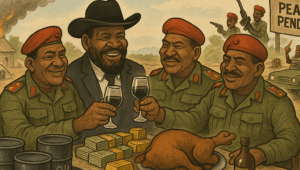
The “rule by decree” refers to the practice of the president or head of state issuing legally binding decrees without parliamentary debate, legislative approval, or judicial review. In fragile or unstable countries, such decrees frequently substitute conventional governance, undermining institutions designed to serve as checks and balances.
South Sudan, the world’s newest country, has become a classic example. Since gaining independence in 2011, presidents have used decrees to remove officials, dissolve parliaments, redraw state borders, and rearrange political alliances. This may be justifiable in an emergency, but in South Sudan, decree has become the usual form of rule.
What was the result? Concentration of authority in the hands of a single individual—the president. And when one man governs, the border between leadership and dictatorship is frighteningly narrow.
The disadvantages of ruling by decree include:
- Concentration of power.
The primary downside of decrees is the centralization of authority. Instead of a government held accountable to the people through representative institutions, the president is the sole decision-maker. In South Sudan, this has resulted in local governors, lawmakers, and even the judiciary being at the mercy of presidential decree.2. Weaknesses of Institutions.
Decrees undermine the independence of parliament, courts, and the civil service. Why should we invest in solid institutions when laws and policies can be changed with a single signature? South Sudan’s parliament has frequently been turned to a rubber stamp body, with presidential orders undermining its effectiveness. Courts rarely dispute decrees because they are aware of their vulnerability to executive retaliation.3. Political Instability.
Far from ensuring stability, decrees frequently spark strife. For example, when President Salva Kiir issued a decree in 2015 to establish 28 states (later expanded to 32), it rearranged borders along ethnic lines and exacerbated local conflicts. The decision heightened community distrust, escalating rather than easing violence.4. Exclusion of citizens
Democracy is built on communication, representation, and involvement. Rule by decree excludes citizens from the decision-making process. Policies develop unexpectedly, frequently without consultation or explanation. For ordinary South Sudanese, this promotes alienation: decisions that affect their lives are made in distant offices with no opportunity for engagement.5. Culture of Fear.
When one man controls, opposition is hazardous. Decrees frequently coincide with crackdowns on critics. Journalists, opposition politicians, and even ruling party members in South Sudan have been incarcerated or silenced for speaking out against presidential directives. Fear hinders debate and stifles creativity.What Decrees Are Really Necessary?
It is unrealistic to claim that decrees should never be employed. In times of true crisis—such as natural disasters, security issues, or unexpected threats—rapid executive action may be required. However, the scope must be limited and time confined.Examples of lawful decree use may include:
- Declaring a state of emergency due to a flood or hunger.
- Quickly mobilizing resources for humanitarian help.
- Security troops are temporarily reorganized to repel an external invasion.
Even in such circumstances, decrees should be subject to subsequent scrutiny by parliament and the courts. Otherwise, what starts as a temporary emergency response quickly becomes permanent dictatorship.
Governance Required in a Country Ruling by Decree.
South Sudan’s reliance on decrees is more than just one leader’s desire for power; it represents a larger governance vacuum. Moving forward, the following are vitally needed:Stronger Institutions.
- Parliament: It must restore its legislative responsibility by considering and approving laws instead than waiting for presidential directions.
- Judiciary: Needs independence, resources, and protection to rule impartially, even against the president.
- Civil service: Should be professionalized so that decisions are made fairly rather than politically.\
- Transparency and accountability.
Every edict should be made public, debated in parliament, and subject to court challenge. Decisions that affect millions cannot be kept hidden in the halls of power.3. Power sharing in practice, not just on paper.
South Sudan’s peace agreements frequently pledged inclusive governance. However, in practice, the president exercises power through decrees. Genuine power sharing needs consultation and compromise, not unilateral directives.What People Should Demand
Citizens are not powerless. Across Africa and around the world, public demand has driven the move from government by decree to constitutional governance. For the South Sudanese, several key demands are essential:1. Constitutional Rule.
The people must insist that the long-awaited permanent constitution be finalized and implemented. A constitution constrains executive power, defines rights, and establishes channels for accountability. Without it, decrees will continue to fill the void.2. Separation of powers.
South Sudanese must demand that parliament and the judiciary be allowed to function independently. The executive branch cannot interfere with judges or dissolve the legislature at will.3. Term Limitations and Leadership Renewal.
The culture of presidents ruling indefinitely by edict must end. Term limits are critical for preventing dictatorships from becoming entrenched and for allowing new leadership to emerge.4. Freedom of Expression.
Citizens who lack freedom of speech are unable to question decrees or push for reform. Protecting journalists, activists, and opposition voices is vital.5. Transitional Justice and Reconciliation.
Decrees have frequently fueled grievances. People must demand accountability for past wrongdoings, including through hybrid courts or Truth Commissions. Without justice, decree rule would invariably be synonymous with impunity.Rule by decree is dictatorship.
Democracy dies when all powers—executive, legislative, and judicial—are concentrated in the hands of a single individual. In South Sudan, this concentration of power has bred a dictatorship masquerading as presidential authority. A president who rules by edict is not the people’s servant but rather their master.Dictatorships rarely provide stability. They cause cycles of insurrection, repression, and renewed violence. South Sudan’s own experience since independence demonstrates the dangers: each edict that repressed criticism exacerbated mistrust, paving the door for new rounds of conflict.
The Way Forward.
South Sudan cannot afford perpetual decree-rule. A nation founded from the struggle for independence must not be bound by the whims of a single ruler. The journey forward requires:
- Constitutional completion: Establishing a permanent constitution that clearly defines the scope of executive power.
- Institutional Strengthening: Invest in an independent parliament, judiciary, and civil service.
- Public Empowerment: Entails ensuring freedoms of expression, assembly, and association.
- Inclusive Governance: Requires decisions to be made by conversation, negotiation, and representation, rather than unilateral directives.
- Establish accountability: Measures, such as monitoring bodies, to contest unconstitutional orders and investigate abuses of power.
Rule by decree may appear to be effective in the short term, but in countries such as South Sudan, it leads to instability, exclusion, and dictatorship. What the country needs is more democracy, not more decrees. South Sudanese citizens must speak out and demand a change from personalized control to constitutional governance.
As long as decrees define law, the dream of independence will be a delusion. However, with a legitimate constitution, solid institutions, and an engaged citizenry, South Sudan may transition from decree to democracy—and finally become the nation its people deserve.