On July 9, 2011, the world saw the birth of a new nation: the Republic of South Sudan. This momentous event marked the end of a long and difficult road to self-determination for the people of Southern Sudan, which had suffered decades of civil war, underdevelopment, and political marginalization. The journey to independence was neither swift nor easy; it required enormous struggle, diplomacy, sacrifice, and, finally, the collective desire of a people yearning for freedom. The referendum received a vote of 98%.
South Sudan’s independence may be traced back to the Comprehensive Peace Agreement (CPA) signed in 2005 between the Sudanese government in Khartoum and the Sudan People’s Liberation Movement/Army. This historic accord ended more than 20 years of civil conflict, which had killed over two million people and displaced millions more. A fundamental element of the CPA was the right of Southern Sudanese citizens to vote in a referendum on whether to remain part of a unified Sudan or split and form an independent state.
The referendum took place in January 2011, following years of preparation and international scrutiny. Despite concerns about logistics, voter registration, and possible manipulation, the process was mostly calm and open. In an extraordinary display of popular will, 98.83% of voters supported independence. The outcome sent a strong message to the world: the South Sudanese people were unified in their quest for freedom, dignity, and self-government.
The referendum results were hardly surprising. Southern Sudan had long been cut off from the political and economic power base in the north. The region suffered from systemic neglect, inadequate infrastructure, and severe poverty. The South, which was mostly Christian and animist, has long felt like a colony within a state, owing to its cultural and theological differences from the largely Arab and Muslim North. The nearly unanimous vote was thus more than a political decision; it represented a symbolic departure from a legacy of oppression and a step into the unknown.
National and International Celebrations.
When July 9, 2011, arrived, euphoria spread throughout South Sudan. Tens of thousands of people gathered at the Dr. John Garang Mausoleum in the new city of Juba to witness the official declaration of independence. The atmosphere was charged with emotion—flags flew, drums beat, and people danced in the streets. The atmosphere was one of joy and pride, tinged with melancholy commemoration of those who had lost their lives in the long war.
President Salva Kiir Mayardit raised South Sudan’s new flag in front of a jubilant audience while wearing his distinctive black cowboy hat, which was donated to him by former US President George W. Bush. In his inaugural address, he recognized the sacrifices of the past and urged inhabitants to band together for a peaceful and successful future. The country’s creation was more than merely the result of a political struggle; it was the fruition of a national dream passed down through centuries.
International festivities reflected the home excitement. The independence celebration was attended by representatives from more than 30 countries, regional leaders, and global luminaries. Messages of solidarity rushed in from all across the world. President Barack Obama hailed South Sudan’s birth as a “new beginning,” while UN Secretary-General Ban Ki-moon called it “a historic day for Africa.” Many observers saw the peaceful transition as a remarkable accomplishment in a region known for war and tyranny.
Diplomatic Recognition and Promises of Peace
South Sudan soon acquired diplomatic recognition from the international community. Within weeks, almost 100 countries recognized the new state, and on July 14, 2011, South Sudan was officially accepted to the United Nations as its 193rd member state. South Sudan’s flag was raised at UN Headquarters in New York, a symbolically charged moment of global acceptance.
The international world offered significant resources to help South Sudan overcome the challenges of state-building. Billions of billions were invested in infrastructure, health, education, and government. Institutions such as the World Bank, the International Monetary Fund (IMF), and numerous non-governmental organizations (NGOs) deployed resources and expertise to support the new government. Countries such as the United States, the United Kingdom, Norway, and China emerged as important allies, providing technical assistance and political goodwill.
At home, the mood was cautiously optimistic. The SPLM-led government promised a new era of peace, unity, and progress. Leaders promised to fight corruption, promote national reconciliation, and create inclusive institutions. They talked about building roads, schools, hospitals, and electricity—basic amenities that had long been denied to the people. The new constitution prioritized democratic administration, human rights, and protection for all ethnic groups.
However, even in these early days of euphoria, underlying tensions persisted. South Sudan inherited serious ethnic divisions, unresolved border issues with Sudan, and a shaky economy that relies nearly completely on oil exports. The majority of the oil infrastructure, however, remained in the North, necessitating collaboration with the old adversary to assure money flow. The leadership also faced the enormous difficulty of integrating previous rebel factions into a national army and administration, which turned out to be far more difficult than expected.
Nonetheless, Independence Day 2011 served as a rare moment of solidarity and hope. For the people of South Sudan, it was more than just the creation of a nation; it was an affirmation of their pain, resilience, and resolve. It provided an opportunity for them to create their own narrative. While the road ahead would be full of unknowns, the significance of that day would last forever.
Challenges Beneath the Surface
Even as flags flew and chants of liberation resounded across the land, real challenges loomed just beneath the surface. South Sudan entered independence as one of the world’s least developed countries. The years of war had devastated its infrastructure, impoverished its institutions, and scarred its people. Most areas lacked basic services like healthcare, education, clean water, and electricity. Many regions of the country had no paved roads, hospitals, or schools.
Furthermore, the country’s economy relied significantly on oil. About 98% of government revenue came from oil exports, with the vast bulk of this oil flowing through pipelines that crossed into northern Sudan for processing and export via Port Sudan on the Red Sea. This dependence put South Sudan in a dangerous economic situation, effectively tying its fortunes to the country from which it had recently seceded.
Another major concern was a lack of national cohesion. While the referendum brought the South together in support of independence, underlying ethnic, political, and military tensions persisted. The SPLM, which constituted the government, was largely seen as the major political force, but it suffered internal conflicts and tensions with other organizations that had fought during the civil war but had not been fully integrated into the new political structure.
Nation-building and the Search for Unity.
From the start, South Sudan’s administration faced the arduous job of establishing a nation from scratch. South Sudan, unlike other post-colonial African governments, had to establish not only a government but also a comprehensive state infrastructure. It had to develop new laws, train civil servants, build security forces, and establish education, healthcare, and taxation systems—all while dealing with insecurity and poverty.
The creation of South Sudan’s Transitional Constitution (2011) was one of the first steps toward nation-building. This legal framework defined the country’s political organization, civil liberties, and governance procedures until a permanent constitution could be written. It established a presidential system in which Salva Kiir served as both head of state and administration. It also promised decentralization, human rights safeguards, and press freedom—though the reality of these ideas would eventually be called into question.
The administration attempted to instill a feeling of national identity beyond ethnic and regional affiliations. Efforts were made to promote unity using national symbols such as the flag, the anthem, public holidays, and the legacy of Dr. John Garang de Mabior, the SPLM’s founding leader who died in a helicopter crash in 2005. Garang’s vision of a “New Sudan” evolved into a guiding ideal for creating a just and inclusive South Sudan, even though it was originally intended to transform the entire Sudan.
However, achieving unity was not easy. South Sudan has more than 64 ethnic groupings, each with its own language, culture, and local government systems. The two main groups, the Dinka and the Nuer, had a long history of rivalry and conflict, particularly over livestock, territory, and governmental influence. The administration, led by Dinka elites, was accused of marginalizing other communities, a problem that would quickly escalate into deeper political and military difficulties.
Role of the International Community
In the months following independence, the international community played a significant influence in molding South Sudan’s destiny. Development agencies, foreign governments, and international financial institutions have poured money into the country. The United Nations established the UN Mission in South Sudan (UNMISS) to promote peace, disarmament, and institution-building. Peacekeepers were sent throughout the country to oversee shaky ceasefires and safeguard people.
At the same time, international contributors sought to promote good governance and democratic norms. Civil society organizations began to form, many of which were supported by international non-governmental organizations (NGOs). They advocated for human rights, accountability, and openness. Journalists and activists saw the early years of independence as a chance to establish the groundwork for a more open and democratic society.
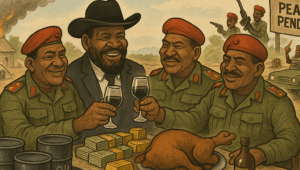
However, expectations were frequently unreasonable. Many international partners underestimated the complexities of South Sudan’s post-war situation and overestimated the new government’s capabilities. Projects were typically disorganized, and corruption in government circles limited help efficiency created by the international partners. Furthermore, the emphasis on strengthening the central government occasionally overshadowed local peacebuilding and reconciliation activities, which could have created bonds and built trust among communities. At that point, the international partners fail to realize that South Sudan is a nation built on the sand, as warlords in office uniforms still cling to their ways.