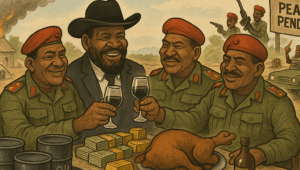
Corruption in South Sudan is more than simply a footnote in the news headlines; it is a pervasive scourge that affects all levels of governance, business, and public life. Corruption ranges from the theft of oil revenues to the use of tribal motivations in political appointments. When South Sudan attained independence from Sudan in 2011, it carried the dreams of millions who want a peaceful, transparent, and democratic state. Instead, decades of civil upheaval, economic collapse, and widespread corruption have largely crushed such dreams.
The extent of corruption is astounding. Authorities purportedly diverted billions of dollars from public coffers, often masquerading as defense spending or emergency procurement. On a smaller scale, everyday folks encounter corruption at hospitals, schools, courts, checkpoints, and police stations. Bribery is often not just an option; it has become a necessity for survival.
Rampant Corruption.
There is no single source of corruption in South Sudan, but rather a tangled web of historical political greed, poor institutions, and tribal enclaves with an us-against-them mentality. One of the most obvious reasons for widespread corruption is the lack of a strong, centralized administration that performs effectively. After decades of civil conflict and displacement, the development of powerful governmental institutions not only delayed tangible progress but utterly disrupted it.
The government’s structure is a delicate, loosely connected patchwork that barely stays together under the weight of tribal politics. Political appointments often prioritize loyalty or ethnicity over merit or expertise. Such an environment leads to a dysfunctional public service system in which untrained leader’s rule, and corruption is both a cause and a consequence of inefficiencies. Corruption can be found in any ministry if the minister is Dinka; for instance, the majority of the minister’s staff will be Dinka’s, possibly a subclan of the minister himself. In this scenario, the system institutionalizes corruption and power to benefit a select group of people or ethnicity.
South Sudan is abundant in natural resources, particularly oil. Instead of rebuilding and investing in infrastructure, education, health, and people, the government has used oil revenue to fuel political warfare and enrich private bank accounts. The opacity surrounding oil contracts, along with a lack of public financial monitoring, makes the oil business fertile ground for grand corruption. It’s a terrible cycle: instability feeds corruption, and corruption feeds instability. Consequently, a handful of elites’ relatives receive the most lucrative corporate contracts.
Power Struggles and Political Instability.
Deep-rooted power battles characterize South Sudan’s political landscape, particularly between President Salva Kiir and his former vice president, Riek Machar. Their fight has not only divided the country along ethnic lines but has also weakened the entire governmental framework. Political leaders frequently use state resources to obtain allegiance through bribery, patronage, and nepotism, which directly contributes to this instability. They also redirected the country’s resources to buy weapons for political survival against the opposition, particularly the president’s supporters.
Transparency suffers at times of conflict. Emergency powers enable governments to circumvent restrictions, making it simpler for money to disappear without accountability. Corruption thrives in such an environment, especially when leaders choose survival over effective administration.
Furthermore, political volatility has rendered long-term anti-corruption initiatives unmaintainable. When power changes hands or a new peace treaty is signed, priorities shift, and institutional improvements are reset or forgotten. The struggle against corruption is usually postponed because survival takes precedence.
Inadequate Mechanisms for Accountability and Transparency.
A big contributor to corruption in South Sudan is the widespread lack of openness and accountability within government systems. Since its independence in 2011, the country has struggled to build strong institutions capable of implementing checks and balances. This institutional deficit has fostered an environment in which corrupt behaviors can grow unabated.
One of the most pressing challenges is the lack of effective oversight in public offices. Many government offices lack effective auditing processes, allowing officials to misappropriate funds with minimal fear of punishment. The procurement process is especially problematic, as contracts are sometimes issued without competitive bidding, resulting in inflated costs and subpar services. This lack of monitoring not only encourages corruption, but it also diminishes public trust in government agencies.
Furthermore, the country lacks independent anti-corruption bodies with the ability and resources to investigate and prosecute corrupt officials. While the South Sudan Anti-Corruption Commission (SSACC) exists, it has minimal capacity and lacks legal support, making it mainly ineffective. Corruption thrives in the absence of strong, independent bodies to hold officials responsible.
The concentration of authority in the executive branch exacerbates the situation. The president has broad powers, including the ability to dissolve legislative assemblies and remove elected governors and other government officials. This consolidation of authority reduces the function of other departments of government in providing supervision, hence undermining accountability systems. (The Enough Project). South Sudan’s government systems lack openness and accountability, making them ripe ground for corruption. Without fundamental reforms to establish effective oversight and strengthen independent anti-corruption institutions, corruption-fighting initiatives would be essentially symbolic.
Nepotism and Patronage Networks.
South Sudan’s political and administrative systems strongly embed nepotism and patronage, significantly contributing to the country’s widespread corruption. The appointments of public officials are frequently based on ethnic affiliations and personal allegiance rather than merit or qualifications. This approach not only undermines the effectiveness of public services, but it also perpetuates a cycle of corruption and favoritism.
Ethnic preference in public sector appointments has resulted in the marginalization of certain groups and the concentration of power in the hands of others. This disparity bred animosity and sparked wars that had weakened the nation. Furthermore, officials selected through patronage networks frequently feel obligated to their benefactors, prompting them to engage in corrupt behavior to keep their positions and pay back favors.
The growth of political elites, who use their positions to enrich themselves and their allies, is another manifestation of patronage networks. These elites frequently wield substantial economic power, including lucrative government contracts and access to foreign aid. They solidify their authority and uphold a system that values allegiance over talent by distributing resources among their relatives and supporters.
This climate undermines transparency and accountability because people in authority and government posts are more concerned with serving the elites who elect them than the public. It also stifles the growth of a professional civil service by filling jobs based on connections rather than talent. To overcome this issue, South Sudan must develop merit-based recruiting and promotion processes, as well as efforts to deconstruct patronage networks and promote inclusive public service.
Transparency and accountability are critical foundations of the battle against corruption in South Sudan. The absence of open governance, insufficient accountability mechanisms, and public officials’ impunity have fostered a culture of corruption that continues to damage national growth, destroy public trust, and fuel conflict. More than ideological vows, rebuilding the nation’s institutions necessitates the implementation of practical reforms that prioritize financial openness, independent audits, public engagement, and strong legal frameworks.
Establishing a transparent public finance system and holding officials accountable through independent anti-corruption organizations are critical steps toward undoing corruption’s damaging impacts. For South Sudan to achieve long-term peace, stability, and prosperity, a real accountability culture must be fostered—one in which both leaders and the population recognize that honesty is not optional, but necessary for a brighter future.
It’s almost a duty for people of South Sudan to stand up and speak the truth to demand the country they want to see. That is why we must speak together with one voice.