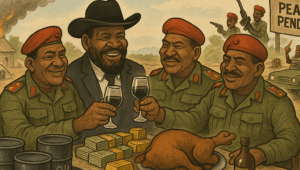
The excitement of independence faded as soon as South Sudan’s administration faced the monumental challenge of basically rebuilding the country from the ground up. South Sudan, unlike other countries that inherited colonial infrastructure, arose as a stateless state, meaning it had internationally recognized borders but lacked the essential mechanisms required to function properly as a state. The leaders didn’t possess any knowledge of building a nation from scratch since all of them were former guerrilla commanders. They were testing the dream of self-rule from a guerrilla and military bird-eye view, which quickly turned to dictatorship or survival.
A Government Without A Blueprint.
The government essentially has no official institutions and functioning national ministries. It made governance extremely challenging since there are no civil employees who can carry out government services to the people. Most bureaucratic positions were filled by ex-military people or political sympathizers with little administrative expertise. There was no well-developed legal system, no working tax authority, and no independent judiciary to settle disputes or uphold justice. Much of the governing strategy was reactive rather than deliberate strategy to govern. Decisions were frequently made informally, behind closed doors, and based on personal relationships rather than laws or procedures. Such practices caused confusion, inconsistency, and widespread inefficiency. Ministries were organized in silos, with no cooperation or communication. Corruption took over and thrived with impunity since there a lack of accountability.
The SPLM and militarization of the state.
The Sudan People’s Liberation Movement (SPLM), which spearheaded the independence struggle to transformed itself from a guerrilla group to a ruling political party, but the process was imperfect and complex. Many of its commanders saw political power as a continuation of wartime leadership, with allegiance taking precedence over competence and disagreement considered betrayal. The prevalence of military people in political positions masked the distinction between governance and armed authority. Security forces such as the army (SPLA), police, and intelligence services were overburdened and politicized. The government spent a disproportionate amount of the national budget—more than 40% in some years—on military and security forces, while education, health, and infrastructure received little funding.
South Sudan’s militarization rendered it less democratic and more autocratic. It also left limited possibilities for citizen participation in governance, reducing public trust in democratic growth.
Oil Wealth Management.
When South Sudan gained independence, it acquired nearly 75% of Sudan’s oil deposits, which became its principal source of revenue. However, the country lacked the ability to successfully manage its wealth. Rather than investing in infrastructure, education, or public services, much of the oil revenue was squandered due to corruption, mismanagement, and favoritism. Government officials lived handsomely while the vast bulk of the population lived in abject poverty. The level of transparency was modest. International partners and monitoring organizations highlighted concerns early on, but improvements were either ignored or opposed.
The economy’s over-reliance on oil made it vulnerable. When political tensions with Sudan resulted in oil production shutdowns in 2012, the economy nearly collapsed overnight, revealing how weak the country’s financial systems truly were.
Tribalism in government and institutions.
Instead of establishing an inclusive and national government, South Sudan’s leadership succumbed to ethnic bias. The Dinka, South Sudan’s largest ethnic group and the most represented in the SPLM, wielded political power, military leadership, and government contracts. Other communities, like the Nuer, Equatorian, Shilluk, Murle, and others, resented this. Instead of creating unity, the political system exacerbated ethnic tensions. Public institutions were viewed as tools for advancing the interests of specific parties rather than as neutral authorities serving all residents. This trend hindered nation-building and raised the prospect of future conflict. Local complaints regarding exclusion and unequal resource allocation contributed to a developing sense of betrayal among the community. Former SPLM allies began to accuse one another of poor governance and ethnic bias, escalating tensions that would lead to civil war.
The Challenges of Decentralization.
South Sudan’s constitution promised a decentralized governance system with greater autonomy for local and regional governments. The objective was to accommodate the country’s various ethnic, cultural, and geographical characteristics. However, rather than serving as a vehicle for unification, decentralization became a cause of instability.
The new federal system, which divided South Sudan into ten states, was intended to empower regional leaders and ensure that resources and authority were distributed evenly throughout the country. However, the distinction between the national and state administrations became blurred, with each contending for control of resources and authority. Instead of promoting cooperation, decentralization resulted in a power struggle, particularly over the oil-rich districts of Upper Nile and Unity Sate.
Furthermore, local governments lacked adequate resources and the ability to manage even basic services. In some cases, local leaders turned corrupt, diverting monies meant for development or abusing their positions for personal benefit. The central government also failed to establish clear guidelines for the operation of local governments and the distribution of funds.
As a result, decentralization, which was supposed to bring governance closer to the people, has become a breeding ground for inefficiency and conflict. Regional leaders, rather than representing their people, frequently became entangled in power battles with national leaders, undermining the entire concept of federalism.
The Role of International Donors and Non-Governmental Organizations
The international community was very invested in South Sudan’s development. During the early years, international aid was critical in keeping the government afloat. The United Nations, World Bank, and numerous non-governmental organizations (NGOs) gave funding for infrastructure, health care, and education. Diplomatic representations from the United States, the United Kingdom, and other African countries expressed strong support for South Sudan’s independence, giving technical and financial assistance to help construct state institutions. However, the reliance on foreign aid and donor money posed its own set of challenges. The help frequently bypassed local governance mechanisms, with non-governmental organizations (NGOs) carrying out projects without adequate consultation with the South Sudan government. Such practices resulted in a parallel system of governance in some places, with foreign firms effectively running local services and eroding the government’s legitimacy and authority.
At the same time, international aid was frequently chastised for being poorly coordinated. Some programs have failed to address the underlying reasons for South Sudan’s poverty and instability. Instead of serving as an instrument for long-term development, aid frequently became a stopgap measure that did little to construct long-term governance institutions. The government, which relied on external assistance, had no motivation to build the robust institutions and revenue-generating processes required for self-sufficiency. Donors and international partners faced a complex and perilous situation as South Sudan’s political crisis escalates.