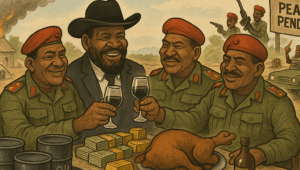
In a country where political expression is both dangerous and restricted, the unwarranted incarceration of political dissidents has become a disturbing feature of South Sudan’s governance. The Blue House, an eerie fortification in Juba that serves more than a national security agency, is often regarded as a silent prison for the politically undesired.
The Mechanisms of Political Detention.
Political dissidents—including opposition leaders, retired military officers, activists, civil society organizers, and even university students—are frequently imprisoned without warrants, due process, or formal charges. Many are arrested under the cover of darkness, detained arbitrarily, and incarcerated for lengthy periods. Some disappear completely.
Detainees cannot access legal counsel, medical treatment, or family visits once inside the Blue House. The detentions are carried out with terrifying precision, frequently by operatives of the National Security Service (NSS), who have broad powers and almost no legal control.
These detentions are usually intended to silence dissent. Individuals accused of supporting rebel groups or opposing government policy, for example, are classified as “national security threats” notwithstanding the lack of evidence. Peaceful protesters or opposition party members are labeled as agitators or traitors.
This practice of enforced disappearances is not only a violation of human rights but also a sort of psychological warfare designed to inspire fear, uncertainty, and acquiescence among the general populace.
Detainees as Political Hostages
In other situations, the incarceration of political dissidents appears to be done strategically, not to punish crimes, but to put pressure on political competitors or stifle opposition movements or surrender. Detainees are used as bargaining chips and released only when they are no longer seen as threats or when international pressure builds.
This approach has turned the Blue House into a kind of political black site, operating outside of any legal or democratic structure. It reflects some of the worst behaviors observed in authoritarian governments around the world, where state security forces serve to defend the regime rather than the people.
Extrajudicial Killings and Forced Disappearances.
Perhaps worse than torture are stories about people who simply disappear. Families of activists, journalists, and opposition members have persistently asserted that the Blue House took their loved ones and never brought them back. Enforced disappearances have become a horrifying reality in South Sudan, and the Blue House is frequently the focus of these allegations. There are terrifying accounts about bodies being thrown in rivers or abandoned in secluded regions with obvious indications of abuse. Some disappearances have gone unresolved for years, with no government acknowledgment, investigations, or closure for the families involved.
International organizations like the United Nations Mission in South Sudan (UNMISS) have consistently demanded investigations, yet their efforts have yielded minimal results. The culture of impunity that surrounds the Blue House makes it nearly impossible to pursue justice. Several whistleblowers have come forward over the years, claiming they were part of security teams ordered to “neutralize threats.” These individuals have since fled the country in fear for their lives, lending credence to claims of systematic killings orchestrated within or ordered by the Blue House.
Political Detention Without a Trial
One of the most serious human rights concerns in South Sudan is the practice of holding people without formal charges or due process, which is often associated with the Blue House. Detainees may be imprisoned for weeks, months, or even years without seeing a lawyer, appearing in court, or being informed of their allegations. One distinguishing feature of these detentions is the complete lack of a judicial process. Some detainees remain in custody for months or years, unaware of the reason for their arrest. Others are tortured into writing confessions, which are then used against them in covert, closed-door hearings, if a trial occurs at all. The vast majority have never seen a courtroom; they just vanish without a trace. Families seeking answers are frequently turned away or told that “there is no record” of the person in custody. Security agents often deny knowing where the detainee is, although all evidence points to their location inside the Blue House.
Many of those jailed are political opponents of the ruling regime, journalists accused of authoring “anti-state” pieces, or activists who have spoken out against corruption or ethnic conflict. These detentions go undetected because there is no functional judiciary, and the rule of law is weak. Reports indicate that the regime interrogates political detainees under coercion and maintains them in appalling conditions, depriving them of food, water, and medical care. Their family frequently does not know where they are or whether they are still alive. These prisoners are often denied access to legal organizations and international observers, contributing to the overall situation’s secrecy. Attacks on the extrajudicial detention system have been intense. South Sudan’s constitution forbids detention without trial, yet the practice continues, defended by ambiguous references to national security and counter-terrorism.
Journalists and Civil Society Silencing.
The Blue House has purportedly been used to silence critics and shape narratives of the current situation in favor of the ruling oligarchy. Journalists who cover corruption, tribal conflict, or military misdeeds frequently suffer detention or threats. Several South Sudanese journalists have been arrested in the Blue House without prosecution. After liberation, some journalists swiftly left the country, determined not to jeopardize their lives once more.
They also target civil society leaders, particularly those who promote democracy, women’s rights, or minority safeguards. Organizing a protest or posting a critical Facebook post can often lead to a late-night visit to the White House. More than just silencing individuals, this repression of free expression also aims to send a message. The danger of ending up in the Blue House has chilling effects on South Sudan’s intellectual and activist communities. As a result, many people choose silence, self-censorship, or exile.
Ethnic and Tribal Targeting.
The Blue House’s operations reflect South Sudan’s longstanding ethnic tensions. According to multiple reports, members of specific tribes, especially those perceived to be connected with opposition groups, are more likely to be jailed and tortured. While the administration disputes this, patterns of arrest and interrogation suggest otherwise.
Ethnic targeting exacerbates hostility and undermines faith in government institutions. For many, the Blue House is more than just a building; it is a tool for ethnic control, where identity can be a crime and disagreement is considered treason. Such behavior has resulted in increased polarization in the country. Instead of being a unifying factor in national security, the Blue House has become a polarizing symbol, signifying both protection and punishment for others.
Global Watchdog Condemnation.
The world is closely monitoring and scrutinizing the Blue House. International human rights organizations have long raised concerns about the alleged atrocities occurring within its walls. Human Rights Watch, Amnesty International, and the United Nations Human Rights Council have all released reports detailing torture, arbitrary detention, and disappearances linked to South Sudanese security forces.
These claims do not appear in passing; they are based on interviews with former detainees, leaked documents, satellite photos, and direct testimony from whistleblowers. The regularity of the charges throughout various years and administrations implies that they are not isolated events but rather part of a larger system of abuse. In response to these discoveries, global organizations have repeatedly pushed the South Sudanese government to let international inspectors into the facility, implement more transparent legal frameworks, and hold those guilty of crimes accountable. Unfortunately, most of these calls have gone unanswered.
Western countries, including the United States, the United Kingdom, and members of the European Union, have also sanctioned key South Sudanese leaders for human rights violations. Even so, these measures have had minimal impact on the Blue House’s operations.
Lack of Accountability and Judicial Recourse.
The absence of an independent judiciary in South Sudan is one of the most significant barriers to justice. Political pressure exerts a significant effect on courts, and judges are frequently too intimidated—or too loyal—to prosecute charges involving state security forces or the National Security Service. Even when families attempt to obtain legal assistance for their incarcerated loved ones, they face enormous obstacles. Lawyers are frequently denied access to inmates, and pleas for habeas corpus are ignored. As a result, victims of abuse are unable to seek justice or reparation.
The absence of accountability is systematic. There are no public reports, transparent investigations, or prosecutions. Those in authority continue to operate the Blue House with impunity, perpetuating the cycle of cruelty. This judicial vacuum reinforces fear and unfairness in society, impeding any opportunity for internal transformation.
Former detainees provide firsthand accounts of their experiences.
Behind the figures and stories are actual people—men and women who underwent unspeakable pain inside the Blue House. Some have fled to neighboring nations or sought shelter overseas. One former detainee, a Juba-based journalist, recalled being detained in complete darkness for 27 days, handcuffed and assaulted with electric wires. They sought names. They believed I had leaked photographs of a military convoy. I kept saying no, but they didn’t care. They simply wanted someone to punish. An opposition party member reported that they had arrested him without a warrant and transported him to the Blue House. They ordered him to sign a confession of rebellion or risk death. “You can’t understand fear until you’ve been there. You begin praying for death. It’s preferable to stay alive there.”
These are only a few of the countless voices. NGOs dealing with refugees and ex-detainees have compiled dozens of such testimonies, resulting in a consistent and horrifying picture. The psychological toll is just as high as the physical. Survivors frequently suffer from PTSD, depression, and long-term trauma, which impairs their reintegration into society.
The Silence of the Family Left Behind.
Every individual who shares their story deprives many others of the same opportunity. Family members of the disappeared frequently live in a condition of limbo, unsure whether their loved ones are alive or dead. They knock on government doors, fill out missing person reports, and pray for information. The majority get none.
Mothers hold photographs of sons who have vanished. Children often ask what happened to their fathers. Wives wait for years with no news. The quiet is stifling, and the Blue House becomes a symbol not only of power or torture but also of unending grief.
In South Sudanese society, where extended family ties are highly valued, these disappearances inflict emotional scars that span generations. A culture of terror permeates daily life, eroding community trust in government institutions.
The Trauma of Isolation and Terror.
for weeks or months at a time. They are placed in small, windowless chambers, fully isolated from human interaction, light, and a sense of time. The purpose of this setting is to break the spirit, and for many, it succeeds.
Released detainees have reported the terror and paranoia that persist after their ordeal. Some people experience repeated nightmares. Others experience post-traumatic stress disorder (PTSD), severe depression, or dissociative episodes. The worry of being re-arrested or tracked pervades people’s daily lives.
In addition to being isolated, captives are subjected to verbal abuse, mock executions, and psychological manipulation. Guards use psychological tactics to break down detainees, such as pretending to phone their relatives to announce their “execution” or forcing them to listen to others being tortured. This constant assault on the mind has a deliberate goal: to undermine resistance, obliterate individuality, and transform people into silent survivors who rarely dare to speak up.
Impact on Families and Communities.
The devastation does not end with the detainees. The abrupt and unexplained disappearance of a loved one causes trauma for whole families. Parents, siblings, spouses, and children wait hopelessly for news, not knowing whether their loved one is alive, being tortured, or has died. People who have been arrested and taken to the National Security’s blue house have a 30% chance of survival. The majority of the people died here.
This uncertainty poisons family interactions and causes a chain reaction of terror, fear, and silence throughout communities. Many families shun political discussions and neighborhood meetings and even relocate to avoid surveillance. Others endure financial difficulties because their major breadwinner remains imprisoned without reason or help. Communities start to self-censor. Activists abandon causes. Journalists close down publications. As a result, the national discourse begins to deteriorate and is replaced by whispers of fear and anxiety.
The Blue House: A Psychological Warfare Tool.
The Blue House is more than just a physical detention facility; it is a tactic of psychological warfare used by the government to coerce and traumatize opponents to abandon their cause. The mere prospect of being taken to the Blue House has become a psychological weapon used to subdue the populace and opposition voices. The inhuman torture and killing at the Blue House is part of a larger attempt to develop a culture of silence and submission, in which people control their thoughts for fear of unseen watchers. It is, at its root, authoritarianism perfected—not via open warfare, but by manipulating the human psyche.
Reclaiming Justice: What the People of South Sudan Must Do.
The Blue House is a physical and metaphorical testament to the tyranny of the South Sudan government against its people. Countless voices have been muffled within its walls, including journalists, activists, political opponents, and innocent people who were jailed without due process, tortured, or disappeared without a trace. Change in South Sudan will not come from the top but must come from the people. Real reform comes when citizens refuse to accept abuse as the norm. It begins with communities coming together across ethnic and political lines to demand fairness, transparency, and the rule of law. We must stop the tribal agenda at its source.
The people of South Sudan must raise their voices—peacefully but decisively. They must advocate for judicial independence, remove restrictive legislation, and promote civil society organizations and independent media. It is critical that survivors of incarceration and abuse be enabled to speak up and that their testimony be heard, documented, and safeguarded.
Youth must be educated about their rights. Women must participate in national dialogues. Faith leaders, tribal elders, and community influencers must unite to speak out against injustice with one voice. On a broader level, the people must advocate for constitutional amendments that limit the National Security Service’s unregulated powers and protect every citizen’s right to free expression, assembly, and political engagement.
People must stand firm to stop torture chambers and secret jails administered in the Blue House. South Sudan belongs to its people—their voices cannot be silenced. It is time for the people of South Sudan to speak together. Together we speak. Together Strong.